
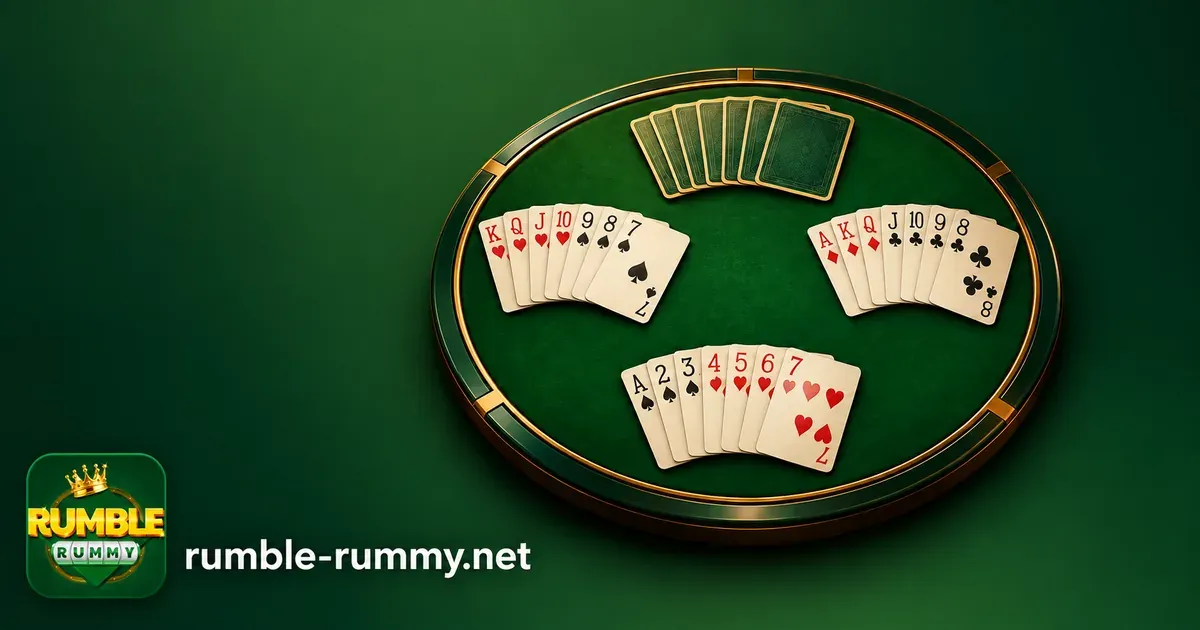
Pool rummy rules turn 13 card rummy into a game of survival. Instead of one deal, you play deal after deal, and your points add up. When your total reaches the limit, 101 or 201, you are out. The last player left wins the prize pool. Here are the pool rummy rules for both versions: elimination, drop scores, rejoining, splitting the pool and a full worked example. The card rules themselves are the standard ones, and the Rumble Rummy games page links to them.
What is pool rummy?
Pool rummy is a format of 13 card Indian rummy for two to six players. Each player pays an entry fee into a prize pool. Every deal is scored as usual: the winner scores zero and the others score the points in their ungrouped cards. Those points are added to each player’s running total.
When a player’s total reaches the elimination score, that player is out. The game continues until one player remains, who wins the pool, minus the platform fee. A deal can be lost cheaply by dropping, which is why pool rummy rules make the drop the most important decision in the game.
Compared with points rummy, a single bad deal does not end your game. A run of them does.
101 pool vs 201 pool
| 101 pool | 201 pool | |
|---|---|---|
| Elimination score | 101 | 201 |
| First drop | 20 | 25 |
| Middle drop | 40 | 50 |
| Maximum per deal | 80 | 80 |
| Typical length | Shorter | Longer |
| Drops you can afford | About 4 first drops | About 7 first drops |
These are common values; check the exact numbers in the table rules of your app. Under 101 pool rummy rules you have little room for mistakes. Under 201 pool rummy rules you can drop more often and recover from a bad run, so games take longer and patience pays more.
Pool rummy rules for elimination and drops
The heart of pool rummy rules is managing your score against the elimination limit.
- Your score only goes up. Every deal you lose adds points. Winning a deal adds zero.
- You are out at the limit. In 101 pool, a total of 101 or more eliminates you.
- Drops are fixed costs. A first drop before your first pick costs 20 in 101 pool. A middle drop costs 40.
- A full loss is capped at 80. But 80 points in one deal can be most of your life in 101 pool.
A practical rule: before each deal, check how many points you can still lose. If you are on 70 in 101 pool, a middle drop (40) would eliminate you, while a first drop (20) would leave you on 90. That changes how you play the opening cards.
Players often count “drops left”: how many first drops they could take before reaching the limit. When your drops left fall to one, play only strong hands and drop everything else at once.
Rejoin and split rules
Rejoining
Many apps let an eliminated player rejoin the same game by paying the entry fee again. Common pool rummy rules for rejoining:
- A rejoin is only allowed while the highest score among remaining players is below a set mark, often 79 in 101 pool and 174 in 201 pool.
- The rejoining player starts at one point above the highest remaining score.
- Some tables limit rejoins to one per player.
Rejoining doubles your cost in that game. Do it only if the remaining players’ scores leave you a real chance, and never to chase a loss.
Splitting the pool
When a few players remain, they can agree to stop and split the prize pool instead of playing on. The split is usually based on each player’s score or drops left, so a player with a lower score receives more. All remaining players must agree.
A split makes sense when the deal could go either way and you prefer a sure share. It makes less sense when you have a clear lead in drops left.
Worked example
Three players, 101 pool, ₹100 entry each, so the pool is ₹300 before the fee.
| Deal | Player A | Player B | Player C | Notes |
|---|---|---|---|---|
| 1 | 0 (won) | 20 (first drop) | 45 | C lost with loose cards |
| 2 | 32 | 20 | 0 (won) | A had no second sequence |
| 3 | 32 | 60 (middle drop) | 25 | B dropped late |
| 4 | 32 | 80 (first drop) | 25 | B on 80, one first drop left |
| 5 | 0 (won) | eliminated, 140 total | 50 | B’s 60 point loss pushed them past 101 |
After deal 5, totals are A 64, C 100, B out. C is one point from elimination. A and C could agree to split, with A taking the larger share because A has more room. Or they play on, and C must play extremely tight. Under these pool rummy rules, C’s next mistake ends the game.
The example shows the main lesson: B lost not because of one bad hand but because of a late drop in deal 3 that ate most of the remaining life.
Your first pool table
Pick 201 pool for your first game: more drops, more room to learn. Count your drops left before every deal.
Strategy tips for pool
- Track drops left every deal, not just your score.
- Drop early rather than late. A middle drop costs twice as much.
- Watch the other scores. When an opponent is near the limit, they will play tight, so expect fewer risky discards from them.
- Do not rejoin to chase. A rejoin is a new buy in.
- Agree splits calmly. Compare drops left before you accept or propose a split, and decline if the numbers favour playing on.
For a shorter format, try points rummy rules. For a fixed number of deals instead of elimination, see the deals rummy rules. Get the app at rumble-rummy.net.
Play Pool rummy18+ only · T&C apply
Pool games can run long, sometimes much longer than planned. Decide in advance how many games you will play and how much you will spend, including any rejoins.