

Good rummy strategy is not a bag of tricks. It is a small number of habits, applied every hand, that slowly tilt results in your favour: build the hardest group first, read what the table is telling you, and know the difference between a card that helps you and a card that only feels useful.
The best rummy strategy is also the least glamorous. There is no secret move that wins on its own, only sound decisions repeated until they become automatic. That is good news for a beginner, because the game rewards discipline more than talent.
The 15 tips below are grouped the way an experienced player thinks, from the base of every hand out to reading opponents and adjusting to the format. Each comes with the reason behind it, because a tip you understand is a tip you will still use in a month.
Know the rules already? Jump in. If not, learn how to play rummy first.
Build the foundation first
1. Make the pure sequence before anything else. This one rule shapes every other decision. You cannot declare without a pure sequence, and until you have one, none of your other groups protect your score. It is also the group a joker cannot help you build, so it is the hardest to finish. Chase it first, while you still have turns to draw what you need. See why you should make the pure sequence first.
2. Do not waste a joker on a run that is nearly pure. A joker is your most valuable card, and it is wasted the moment it goes into a sequence you could have finished naturally. Save jokers for sets and impure sequences built around high cards.
3. Aim for a second sequence early too. A valid hand needs two sequences. Once the pure sequence is safe, your next target is the second sequence, not a set. Sequences use more of your hand and leave fewer loose cards to count against you.
These first three tips are the core of any rummy strategy. Everything else builds on them.
Choose the right cards to keep
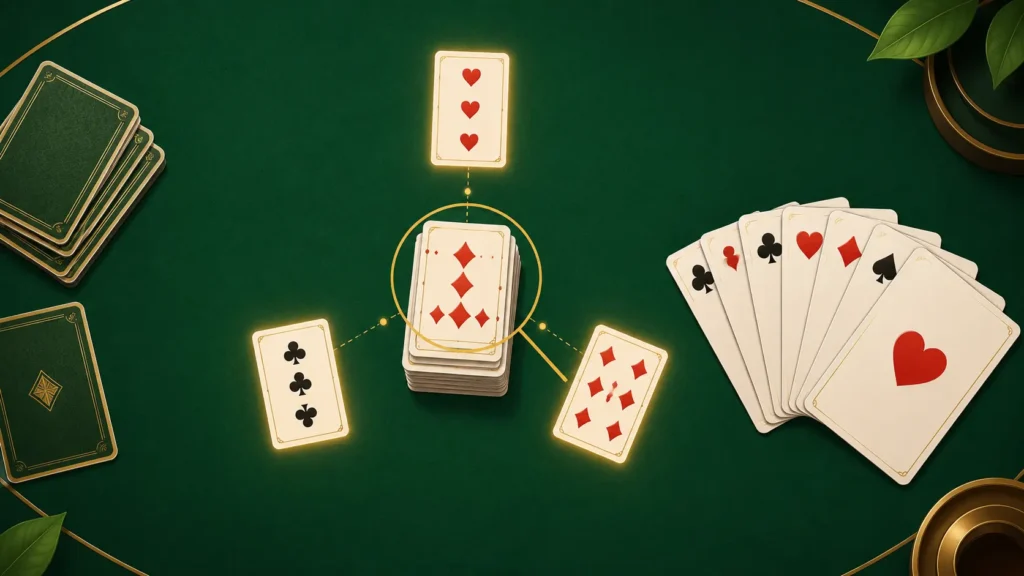
4. Hold your middle cards. The middle cards, roughly 4 to 8, are the most useful in the deck, because each fits more sequences than a high or low card. A seven is a good example: it can complete 5♠ 6♠ 7♠, 6♠ 7♠ 8♠ or 7♠ 8♠ 9♠.
The same seven can finish three different runs. A King or an ace sits at one end only, so it fits far fewer combinations. Hold the flexible cards and let the rigid ones go.
5. Let go of high cards early. Aces, Kings, Queens and Jacks are worth 10 points each if they are still in your hand when someone declares. If a high card is not already part of a group, it is a liability. Discard it early.
6. Keep cards that connect in more than one direction. Two cards next to each other, like the 6♥ and 7♥, are worth more than two unconnected cards, because they can grow into a run from either end. Think about what a card could become, not just what it is.
7. Do not hoard for a dream hand. Holding a pile of nearly useful cards and hoping they all come good is how beginners run up a big score. If a card has not found a home in a few turns, let it go. A patient rummy strategy is not the same as a stubborn one.
Read the table
The open pile and your opponents’ picks are the richest source of information in the game, and most beginners ignore both. Reading them is the part of rummy strategy that separates regular winners from everyone else.
8. Watch what opponents pick up. When a player takes a card from the open pile instead of the closed deck, they need that exact card, almost always to finish a set or a sequence. That tells you what they are building and which cards you should now keep away from them.
9. Read what opponents discard. A card someone throws away is a card they are not collecting. If an opponent discards high cards early, they are probably close to a pure sequence and cutting their penalty.
10. Do not feed your opponents. Before you discard, ask whether the card helps the next player. If you have watched them pick cards near it, hold it and throw something safer. A card that completes their hand is worse than a card that sits in yours.
11. Use the closed deck when you want to stay hidden. Every card you take from the open pile tells the table something. Drawing from the closed deck gives nothing away.
Reading the table in practice
Say the player before you picks the 8♣ from the open pile, and two turns later throws the K♣. They are probably building something around the 8♣, perhaps 7♣ 8♣ 9♣ or a set of eights, and they no longer need high clubs. So hold your 7♣ and 9♣ rather than discarding them, and feel free to throw high clubs yourself. One pick and one discard told you a lot. This kind of small inference, repeated every turn, is where rummy strategy pays off over many games.
Manage your jokers
Jokers win games when they are in the right place, and they are wasted more often than any other card. A good rummy strategy follows a simple order of priority.
12. No second sequence yet? Use the joker there first. If you have your pure sequence but not a second one, your first job for any joker is to complete that second sequence. It brings you closest to a valid hand.
13. Already have two sequences? Put jokers on your highest cards. Once both sequences are safe, use jokers to build sets around high value cards. A joker standing in for a missing King removes the most points from your hand if the deal ends badly.
Know when to fold
14. Drop a bad hand instead of playing it out. If your opening 13 cards give you no path to a pure sequence and little else, dropping early costs a small fixed penalty instead of the full count. Beginners hate to drop because it feels like giving up. Good players treat it as cutting a loss.
A rough rule: if after your first two or three turns you still have no pure sequence in sight and several high cards, a first or middle drop usually beats playing on. A rummy strategy that never drops is a rummy strategy that pays the maximum too often.
Adjust your rummy strategy to the format
15. Play the format, not just the hand. The same rules run through three formats, and the right approach shifts between them. The rummy games on the app page explains each format.
| Format | How to think | Strategy shift |
|---|---|---|
| Points rummy | Fast, one deal, cash value per point | Play tight and decisive. Drop weak hands quickly. |
| Pool rummy | Repeated deals, out at 101 or 201 points | Play for survival. Avoid big penalties and drop when a hand is hopeless. |
| Deals rummy | Fixed number of deals, most chips wins | Every deal counts, so balance aggression with keeping totals low. |
Points rummy rewards fast decisions. Pool rummy rewards patience. Read the format before the first card, because a move that is smart in one can be a mistake in another.
Turning rummy strategy into instinct
None of these 15 tips is complicated. What makes them work is doing them every hand, until building the pure sequence first and reading the open pile become things you do without thinking. That only comes from playing, so the fastest way to improve is to play many hands where mistakes cost nothing. You can play rummy online free to practise.
A weekly practice routine
Pick one group of tips per week and focus only on it:
- Week one: foundation tips 1 to 3. Count how fast you find the pure sequence.
- Week two: card choice tips 4 to 7. Review your discards after each game.
- Week three: reading the table, tips 8 to 11. Note one opponent’s picks every game.
- Week four: jokers, drops and formats, tips 12 to 15.
After a month the whole rummy strategy feels natural instead of like a checklist.
Take it to the table
Pick one tip from this list for your next session, play at the lowest stake and check after ten deals whether it changed your score. Then add the next tip.
Keep expectations honest
Strategy improves your results over hundreds of games, not in one session. No tip, tool or paid group changes the deal, and some sessions will go badly whatever you do. Decide your budget before you play, do not chase losses, and see responsible gaming if play stops being fun.
Practise on Rumble Rummy18+ only · T&C apply
Ready to try these tips at a real table? Get Rumble Rummy and start at the lowest stake.