
How to play rummy is the first question every new player asks, and the answer fits on one page: make sequences and sets from 13 cards, build at least one pure sequence, and declare before anyone else. Here is how to play rummy step by step, from the deal to the declaration, with examples of valid and invalid hands. It follows the Indian 13 card format, which is the one most apps and most families in India use.
Rummy is not just a way to pass time at family gatherings. It tests memory, planning and quick thinking. Most card games rely on the cards you are dealt. Rummy gives you a puzzle to solve before your opponents do, and that is why learning how to play rummy properly pays off.
What is rummy?
To understand how to play rummy, think of it as a draw and discard card game. On each turn you pick one card and throw away one card, slowly turning a messy hand into neat groups.
The objective of the game
The goal is simple: arrange all the cards in your hand into valid sequences and sets. The first player to do this and declare wins the deal. The skill lies in how you get there. Do you throw away high cards early to limit losses? Do you hold a card in the hope of completing a set? Every turn asks a small question.
Why rummy is so popular in India
Walk into almost any Indian home during Diwali and you will find a rummy game somewhere. It is part of festivals, family gatherings and late nights with friends. The 13 card version strikes a balance between skill and fun: easy to learn in an evening, deep enough to keep you thinking for years. Learning how to play rummy at home is how most players in India start.
What you need to play rummy
Before we get into how to play rummy turn by turn, here are the basics you need at the table.
Number of players
- 2 to 6 players in most formats.
- More players means more competition and longer deals.
Standard deck of cards
For 2 players, one 52 card deck plus one printed joker works. For 3 to 6 players you usually need two 52 card decks shuffled together, which gives 104 cards plus 2 printed jokers.
Joker cards explained
Jokers are wild cards that can stand in for any card in an impure sequence or a set. There are two kinds:
- Printed joker: the joker card that comes in the deck.
- Wild card joker: a card picked at random at the start. If the 7 of hearts is picked, every 7 becomes a joker for that deal.
A big part of how to play rummy well is using jokers wisely. Spending one on a group you could complete with natural cards is a common beginner mistake.
Points system overview
Every card has a point value, and knowing them is part of how to play rummy. When someone else declares, the cards you have not grouped count against you.
| Card type | Points |
|---|---|
| Face cards (K, Q, J) | 10 points each |
| Aces (A) | 10 points each |
| Number cards (2 to 10) | Face value, so the 5 of hearts is 5 points |
| Jokers | 0 points |
If you are stuck with a King and a Queen when someone declares, that is 20 points against you. Learning how to play rummy well starts with keeping that number low.
Rummy card game rules explained
These rummy card game rules apply to every format. Know them before you sit at any table.
Card rankings
Cards rank from Ace to King. The ace can be low in A, 2, 3 or high in Q, K, A of the same suit. It cannot wrap around, so K, A, 2 is not a sequence.
Valid sequences
A sequence is three or more cards in a row of the same suit. It is the backbone of your hand, and there are two kinds.
Pure sequence
A pure sequence is made of consecutive cards of the same suit with no joker standing in for a missing card.
- ✅ Valid: 4♠ 5♠ 6♠
- ✅ Valid: 10♦ J♦ Q♦ K♦
- ❌ Not pure: 4♠ 5♠ Joker (that is an impure sequence)
Why does it matter so much? Without a pure sequence you cannot make a valid declaration. This one rule is the heart of how to play rummy in the Indian format.
Impure sequence
An impure sequence uses a joker to replace a missing card.
- ✅ Valid: 4♠ 5♠ Joker (the joker stands in for 6♠)
- ✅ Valid: 8♦ 9♦ Joker J♦ (the joker fills the gap)
Sets
A set is three or four cards of the same rank in different suits.
- ✅ Valid: 5♠ 5♥ 5♦
- ✅ Valid: 8♣ 8♥ 8♦ 8♠
- ✅ Valid with joker: 7♣ 7♥ Joker (the joker stands in for 7♦)
- ❌ Invalid: 5♠ 5♥ 5♠ (two cards of the same suit)
Invalid combinations
- Two identical cards of the same suit in one set: invalid.
- Any joker used to replace a card in a pure sequence: it is no longer pure.
- Four cards where two share a suit: that is not a set.
How to play rummy step by step
Now you know the rules. Here is how to play rummy step by step in a real deal.
Step 1: Deal the cards
The dealer shuffles and gives 13 cards to each player. The rest form the closed deck, face down in the middle. The top card is turned face up to start the open pile, and one card is drawn to set the wild joker.
Step 2: Pick a card
On your turn you have two choices:
- Draw from the closed deck. Safe, and nobody sees what you took.
- Pick from the open pile. Your opponents see the card, but it may be exactly what you need.
Step 3: Discard a card
After you pick, throw one card onto the open pile so you keep 13 cards. Strategy starts here: do you discard a high card to cut your risk, or a card your opponent might want?
Step 4: Form sequences
Group your cards. Look for a pure sequence first, because you cannot declare without it. Then work on a second sequence, which can be impure.
Step 5: Arrange sets
Put the remaining cards into sets. Save jokers for gaps you cannot fill with natural cards.
Step 6: Declare your hand
When all 13 cards sit in valid groups, with at least two sequences and one of them pure, you declare. Online, you press the declare button. At home, you show your hand. A wrong declaration, such as a missing pure sequence, costs a heavy penalty, usually 80 points.
That is how to play rummy in six moves. The rest is practice.
A sample hand, turn by turn
Here is how to play rummy with a real hand, so the steps above feel concrete. Say the wild joker for this deal is the 9 of clubs, so every 9 is a joker. You are dealt:
4♥ 5♥ 6♥ · 8♠ 9♦ · J♣ Q♣ · 3♦ 3♠ · K♥ K♦ · 2♣ 7♦
First, look for what is already done. 4♥ 5♥ 6♥ is a pure sequence. That is the most important group, and you have it on the first look. The 9♦ is a joker, so 8♠ and the joker could become part of a set of eights or an impure run. J♣ Q♣ needs a 10♣ or K♣. 3♦ 3♠ needs one more 3. K♥ K♦ needs one more King.
Turn one: the open card is the K♠. You pick it, because it completes K♥ K♦ K♠ as a set. You discard the 7♦, which does not connect to anything.
Turn two: you draw the 10♣ from the closed deck. Now J♣ Q♣ 10♣ is a second pure sequence. You discard the 2♣.
Turn three: you draw the 3♣. Now you have 3♦ 3♠ 3♣ as a set. You are left with 8♠ and the 9♦ joker, which is two cards and not a group yet. You discard nothing useful and wait.
Turn four: you draw the 8♥. Now 8♠ 8♥ and the joker form a valid set of eights. Every card is grouped: two pure sequences, two sets and one set with a joker. You declare and win the deal.
Real hands are rarely this kind, but the order of thinking is always the same. That order is the core of how to play rummy: pure sequence first, second sequence next, then sets, then use the joker on whatever is left.
How to play Indian rummy

Indian rummy is the most popular version in the country, and it is the format most apps use. Here is how to play rummy the Indian way.
13 card Indian rummy rules
- Each player gets 13 cards.
- Two decks of 52 cards plus jokers are used for 3 or more players.
- Two types of jokers: printed and wild card.
Every detail of the format is in the 13 card rummy rules.
Importance of a pure sequence
Pure sequence first. That rule drives everything else. In Indian rummy, a declaration without a pure sequence is invalid however good the rest of your hand looks. Build it before you worry about sets or impure sequences.
Valid declaration requirements
To declare you need:
- At least two sequences, one of which must be pure.
- All remaining cards in valid sequences or sets.
- No card left over.
Winning conditions
- The first player to declare a valid hand wins the deal.
- The other players count the points in their ungrouped cards.
- In pool rummy, the game continues until players pass a score limit such as 101 or 201 and drop out.
How scoring works after a declaration
Once a player declares a valid hand, the others show their cards. Here is how to play rummy scoring in the Indian format:
- Cards that sit in valid groups count zero, as long as the player has the required pure sequence.
- Without a pure sequence, every card in the hand counts, even if the sets are complete.
- Face cards and aces count 10, number cards count their face value, jokers count zero.
- The usual maximum in one deal is 80 points.
So a player holding K♣ Q♦ 7♠ outside any group, with a pure sequence on the table, scores 27 points. The same player with no pure sequence scores every card in the hand, up to the 80 point cap. That gap is why every strong player learning how to play rummy builds the pure sequence first.
Pure sequence vs impure sequence
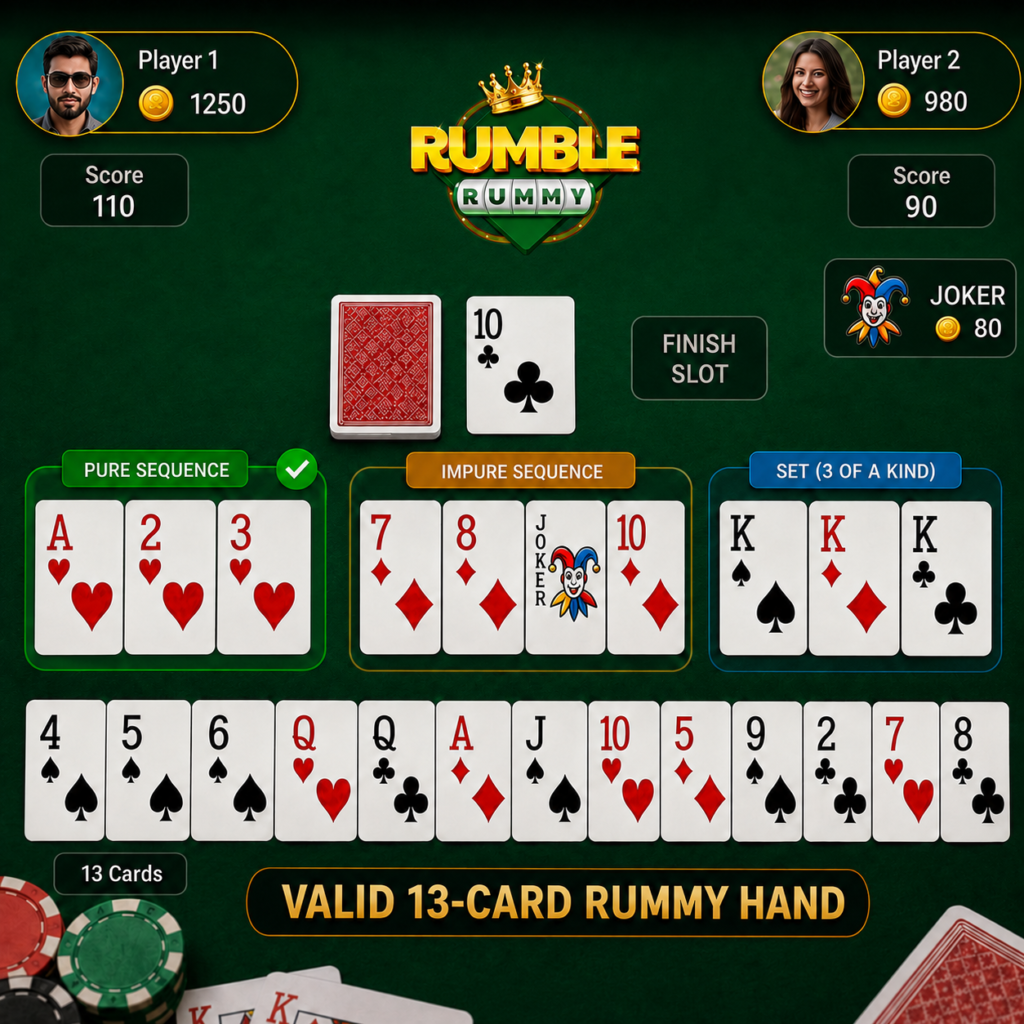
This is where most beginners get tripped up, so here are the two side by side. Every edge case is in pure sequence vs impure sequence.
What is a pure sequence?
A pure sequence is a joker free run of consecutive cards in one suit.
- ✅ A♠ 2♠ 3♠ 4♠ (pure sequence of four)
- ✅ 8♥ 9♥ 10♥ (pure sequence of three)
- ✅ Q♦ K♦ A♦ (the ace can be high)
- ❌ K♦ A♦ 2♦ (no wrap around)
A longer pure sequence gives you more freedom with the rest of your hand.
What is an impure sequence?
An impure sequence uses a joker to replace a missing card.
- ✅ 4♣ 5♣ Joker (the joker stands in for 6♣)
- ✅ 9♦ Joker J♦ Q♦ (the joker stands in for 10♦)
Common beginner mistakes
- Holding jokers for later while the pure sequence never comes. Use them when they complete a group.
- Forgetting you need two sequences. One pure sequence is mandatory, and a second sequence, pure or impure, is also required.
- Mixing suits. A♠ 2♥ 3♠ is not a sequence.
Types of sets in rummy
Sets are your second building block after sequences.
Three card sets
Three cards of the same rank in different suits: 5♠ 5♥ 5♦, or K♠ K♥ K♦.
Four card sets
Four cards of the same rank, one from each suit: 3♠ 3♥ 3♦ 3♣.
When to use jokers in sets
A joker can complete a set: 7♠ 7♥ Joker is valid. A set can never hold two cards of the same suit, even with two decks in play.
Valid and invalid examples
| Example | Verdict |
|---|---|
| 5♠ 5♥ 5♦ | ✅ Valid set |
| 5♠ 5♥ 5♠ | ❌ Invalid, duplicate suit |
| 5♠ 5♥ Joker | ✅ Valid (joker = 5♦) |
| 5♠ 5♥ 6♦ | ❌ Invalid, different ranks |
How to win a rummy game: key habits
Knowing how to play rummy is one thing. Winning more often takes habits. These are the ones that matter most.
Build a pure sequence first
Make it your target in the first few turns. Once it is done, everything else is easier and your risk drops.
Watch opponent discards
Every discard tells you what an opponent does not need. If someone throws the 7 of hearts, they are probably not building a hearts run around it. When an opponent picks from the open pile, note the card. You will soon see what they are collecting.
Use jokers wisely
- Do not use a joker to finish a set you could complete with natural cards.
- Do use jokers for an impure sequence when your hand is stuck.
Reduce high value cards
Face cards and aces count 10 each if someone declares before you. Throw them early unless they belong to a promising group. That habit alone changes how to play rummy at low risk.
Plan your declaration
Check every group before you declare, because a careful check is the last step of how to play rummy without penalties. Is that sequence really pure? Is every set valid? Waiting one more turn is better than an 80 point wrong declaration.
Know when to drop
You can drop out of a deal early in every format. A first drop costs fewer points than a middle drop, and both cost less than losing with a full hand. If your opening cards have no sequence in sight, dropping is often the smart move.
Mistakes to avoid
- Ignoring the pure sequence until it is too late.
- Holding too many face cards that are not connected to anything.
- Giving away your plan by discarding a whole suit in a row.
- Declaring too early without the second sequence.
- Using a joker in a pure sequence, which makes it impure.
Our rummy formats on Rumble Rummy page explains how drops and scores work in each format.
Practise rummy on a real table
Reading about how to play rummy only takes you so far. The real learning happens when you play, make mistakes and see why they cost you.
Different types of rummy games
| Game type | Best for | Key feature |
|---|---|---|
| Points rummy | Short sessions | One deal; each point has a fixed rupee value |
| Pool rummy | Longer sessions | Players drop out when they pass 101 or 201 points |
| Deals rummy | A fixed finish | Set number of deals; most chips at the end wins |
| Gin rummy | Two players | Different rules; not the Indian format |
For a beginner, points rummy is the easiest place to start. Each deal is short, so you learn from many hands quickly.
Online rummy vs offline rummy
| Factor | Offline rummy | Online rummy |
|---|---|---|
| Speed | Slower, manual shuffling | Fast, automatic dealing |
| Practice | Needs friends or family | Available any time on free tables |
| Social side | Face to face | Chat at best |
| Money | Friendly stakes | Cash tables with entry fees and platform fees |
A good plan is to learn on free tables, then play small stakes once you can declare without mistakes.
A two week practice plan
If you want a simple way to practise how to play rummy, try this:
- Days 1 to 3: play free tables and only focus on finding the pure sequence quickly.
- Days 4 to 7: start tracking what your opponents pick from the open pile.
- Days 8 to 10: practise dropping bad hands early and compare your scores.
- Days 11 to 14: play full games and check every hand twice before you declare.
Keep a note of wrong declarations. If you make none in a week of free play, you are ready for the lowest stakes. If you want to try what you learned here, you can practise on Rumble Rummy today.
Practise on Rumble Rummy18+ only · T&C apply
Final checklist
- Know the difference between pure and impure sequences.
- Make the pure sequence your first goal every deal.
- Keep high cards low unless they belong to a group.
- Check your hand before you declare.
- Practise on free tables before you play for money, and set a budget when you do.
Now you know how to play rummy. Play slowly at first, and the speed will come.