
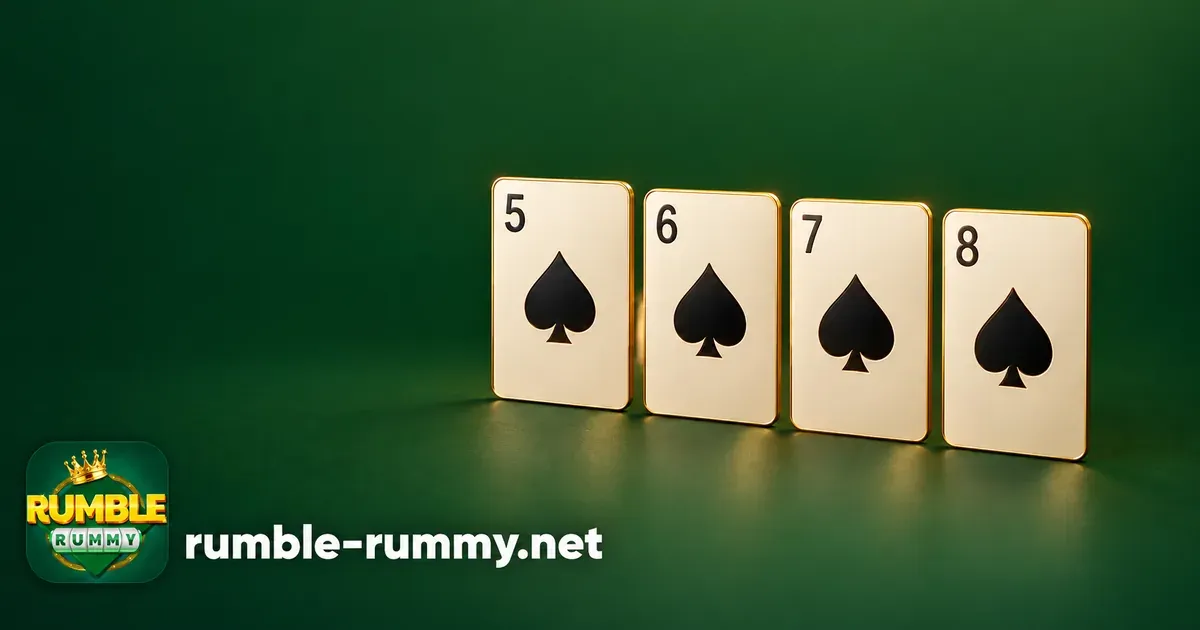
A pure sequence in rummy is three or more consecutive cards of the same suit, with no joker used anywhere in it. It is the one group you cannot win without, and it is the rule that separates players who declare from players who sit holding a tidy hand the game refuses to accept.
Most beginners understand what a sequence is within a minute. Where they lose money is the word pure. They build a run with a joker, feel ready to declare and discover at the worst moment that it does not count. Here is the pure sequence in rummy, piece by piece: what qualifies, what does not, how it works with jokers and the ace, and the mistakes that turn a winning hand into an 80 point loss.
Still learning the basics? The 13-card rules cover the whole game. Here we go deep on the one group that decides it.
What a pure sequence in rummy actually is
Three conditions, and all three must be true at once.
Consecutive. The cards run in order, one rank after the next, with no gaps.
Same suit. Every card shares a suit. Three sevens will not do, however neat they look, because a run is about order, not matching ranks.
No joker. This is the condition the name points to. The moment a joker stands in for a missing card, the run is no longer pure. It becomes an impure sequence: a valid group, but not the one that lets you declare.
Here is a pure sequence in rummy:
4♠ 5♠ 6♠
And a longer one, just as valid:
9♥ 10♥ J♥ Q♥ K♥
Both run in order, both keep to one suit, and neither uses a joker. That is all a pure sequence in rummy has to be.
How many cards a pure sequence needs
The minimum is three. Two consecutive cards of the same suit are not a sequence at all. You can build longer ones, and a four or five card pure sequence in rummy is often a smart move, because it uses more of your hand and leaves fewer loose cards to count against you if someone else declares first.
There is no fixed maximum, but you hold 13 cards and need at least one other sequence, so in practice a pure run tops out well short of that. Four or five cards is the useful range.
A long run also gives you options. If you hold 5♦ 6♦ 7♦ 8♦ and later need a 5♦ elsewhere, you can split the run and keep 6♦ 7♦ 8♦ as your pure sequence in rummy while the 5♦ joins another group.
Can you have two pure sequences?
Yes, and it is a strong position. The rules ask for at least one pure sequence and at least two sequences in total. If both are pure, you have met the requirement twice over, and your jokers are free for sets or a third run. Many experienced players aim for two pure runs early in a deal when the cards allow it, because it removes the risk of a joker being needed in the wrong place later. Just remember that a second pure sequence in rummy is a bonus, not a requirement.
The pure sequence and the ace
The ace trips up players who come from other card games, so it is worth being exact.
The ace can sit at the bottom of a run, next to the two, or at the top, next to the King. Both of these are pure sequences:
A♠ 2♠ 3♠ and Q♠ K♠ A♠
What the ace cannot do is join the top and bottom together. A run does not wrap around, so this is not a sequence:
K♠ A♠ 2♠
If you are holding this and counting on it as your pure sequence in rummy, you are holding three loose cards worth 22 points.
Pure vs impure sequence: the difference
This is the difference that costs beginners the most, so slow down here.
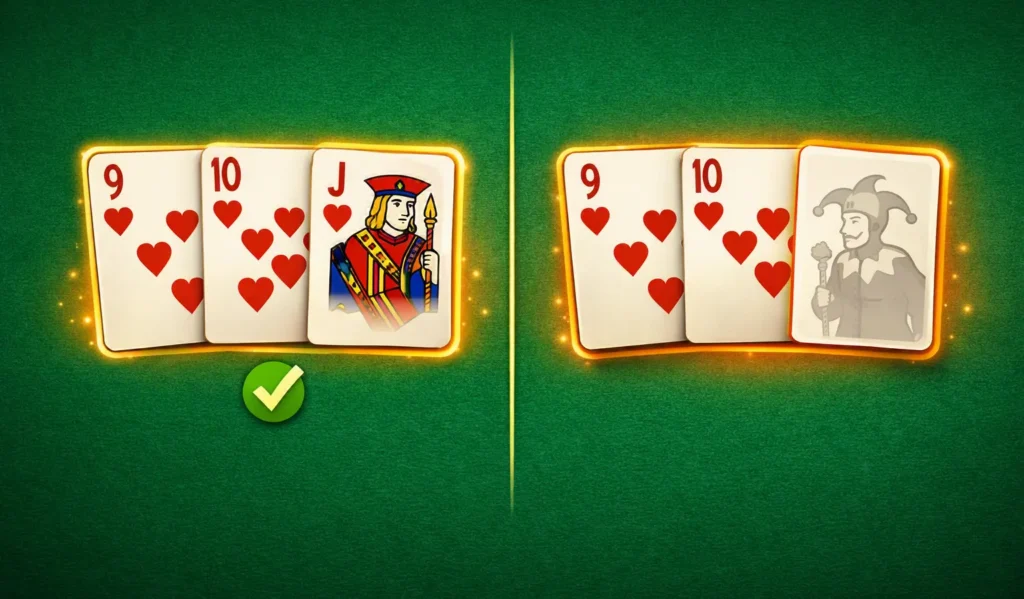
An impure sequence is a run of one suit where a joker fills a gap. It is a valid group. You can use it, and it can be your second sequence. What it cannot do is meet the pure sequence requirement.
Say the wild joker for the deal is the six. Compare these two runs:
9♥ 10♥ J♥ versus 9♥ 10♥ and a joker
The first is pure: three hearts in order, no joker. The second uses a joker in place of the J♥, so it is impure. Both are valid sequences. Only the first counts as your pure sequence in rummy.
| Pure sequence | Impure sequence | |
|---|---|---|
| Uses a joker as a substitute | No | Yes |
| Counts as your required sequence | Yes | No |
| Allowed as a second group | Yes | Yes |
| Minimum cards | 3 | 3 |
Read the second row twice. You can build a hand of neat impure sequences and sets, look down at 13 organised cards and still be unable to declare, because none of them is pure.
The one time a joker card is still pure
This looks like a contradiction until you see it clearly.
When a rank is chosen as the wild joker, every card of that rank becomes a joker for the deal. But you do not have to use it as a joker. You can play it as its natural self.
Suppose sixes are wild, and you hold:
4♠ 5♠ 6♠
This is still a pure sequence in rummy. The six of spades sits in its natural place and plays as a six, not as a wild card. The rule is about whether a joker is substituting for a missing card, not whether a joker card is physically in the run.
The same logic does not apply to the printed joker. It has no natural rank, so any run that includes a printed joker is impure.
Common mistakes with the pure sequence
Treating an impure sequence as good enough. A joker in your run feels like progress, and it is, but it does not meet the requirement. Build a real pure sequence in rummy before you count yourself close to declaring.
Saving the pure sequence for last. It needs specific cards in a specific order, and a joker cannot help. It is the hardest group to finish, which is exactly why you build it first, while you still have turns to chase the cards you need.
Wasting jokers near the pure run. Jokers are worth most in sets and impure sequences, where they replace hard to find cards. Spending one on a run that is nearly pure anyway wastes your most valuable card.
Assuming the ace wraps around. K, A, 2 is not a sequence. The ace goes high or low, never both.
Misreading the suit. Under time pressure it is easy to read a run as one suit when one card is the other suit of the same colour. Hearts and diamonds are both red. Check the symbol, not the colour.
Breaking a finished pure run. Once you have your pure sequence in rummy, do not discard from it to chase a set. Losing it can cost you the whole deal.
For more habits that help at the table, see the rummy strategy tips.
Why the pure sequence decides your score
Most players stop thinking about it once they can declare. The pure sequence in rummy reaches further, into how much a bad deal costs you.
Cards inside a valid group do not count against you. Arrange most of your hand and your points fall. But there is a catch, and the pure sequence is the key to it.
Without a pure sequence, your groups are not recognised for scoring. The whole hand counts as loose cards, even the parts you organised. You can hold four tidy groups and still pay close to the maximum of 80 points, only because the one required run is missing.
So the pure sequence in rummy is not only your ticket to declare. It is what turns every other card from a penalty into an arranged card. That is the real reason to build it first.
A quick scoring comparison
Two players lose to the same declaration. Both hold a set of Kings, an impure run and two loose cards worth 9 points.
- Player A also holds a pure sequence. Score: 9 points.
- Player B has no pure sequence. Every card counts. Score: 80 points, the cap.
Same cards, same effort, a 71 point difference. In a points game at ₹1 a point, that is ₹71 on one deal.
Practise the pure sequence for free
Spotting a pure sequence in rummy quickly is a skill that turns into instinct with repetition, and you do not need to risk money to build it. Practice tables use chips with no cash value and the same rules.
Play a run of practice hands with one goal: find the pure sequence first, every time, before you touch a set or an impure run. After a dozen hands you stop calculating it and start seeing it. The rummy game formats page explains where practice and low stake tables fit.
Playing responsibly
Skill improves your results over many games. It does not remove the chance of losing money in any single session. Decide your budget before you play, not after a loss, and do not chase losses.
Practise on Rumble Rummy18+ only · T&C apply
Ready to try it? Get Rumble Rummy and build your first pure sequence at a real table.