
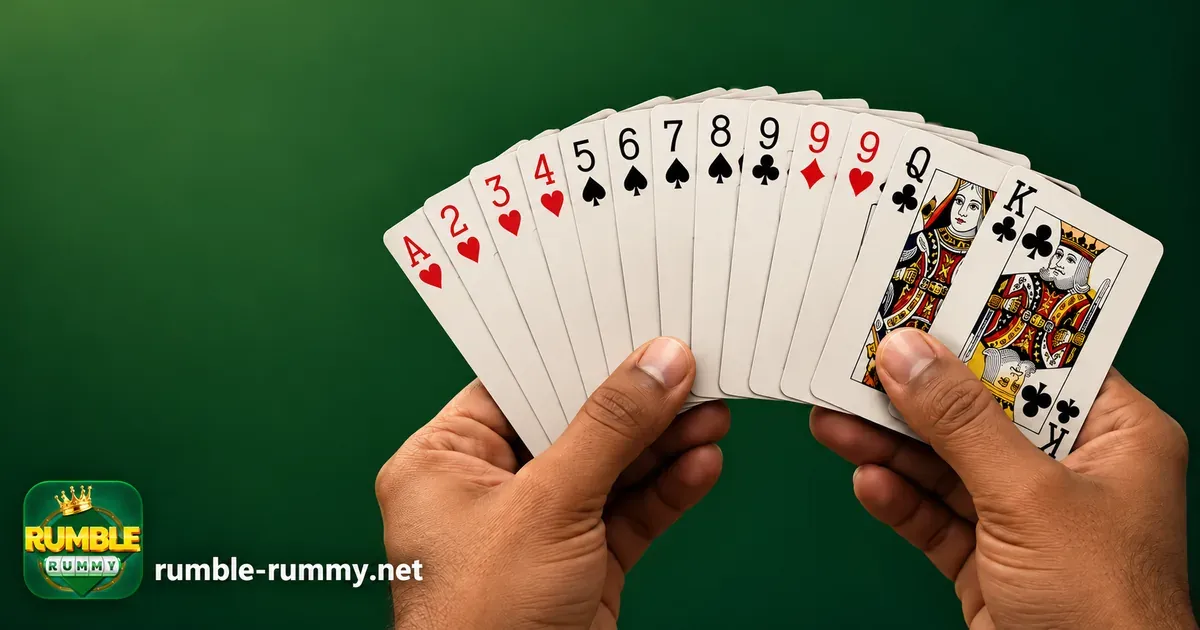
13 card rummy rules tell you how to make valid sequences and sets, how to use jokers and when you are allowed to declare. They are the rules most families in India grew up with, and the same rules every rummy app uses. Here are the 13 card rummy rules one by one, with examples of valid and invalid hands, the scoring system and a full example game.
If you are completely new, start with our how to play rummy for beginners and come back here for the details.
What are the 13 card rummy rules?
Overview of the game
13 card rummy is a draw and discard game. Each player gets 13 cards, and the first player to arrange all of them into valid groups wins the deal. The game uses one or more standard 52 card decks, plus printed jokers and a wild joker chosen at random.
Why it is popular in India
Indian rummy is the most played card game in the country. It is simple to learn but full of choices. You can play a quick game online or a long session with family, and the 13 card rummy rules stay the same either way.
13 card rummy and other versions
| Version | Cards per player | Pure sequence needed | Common in India |
|---|---|---|---|
| 13 card Indian rummy | 13 | Yes | Yes, the standard |
| 21 card rummy | 21 | Yes, often three sequences | Less common |
| 10 card or Gin rummy | 10 | Different rules | Rare |
The 13 card rummy rules are the ones online apps use for points, pool and deals tables.
Objective of 13 card rummy
The aim is to arrange all your cards into valid sequences and sets. You need at least two sequences, and one must be a pure sequence in rummy, which means no joker standing in for a card. Once that is done, the rest of your cards can go into more sequences or sets.
13 card rummy: how to play
Number of players
A game is usually played with 2 to 6 players.
How many decks are used
The 13 card rummy rules on decks depend on the table size:
- For 2 players, one 52 card deck with a printed joker is common, though many apps use two decks.
- For 3 to 6 players, two decks of 52 cards are standard.
- Some home games with 6 players add a third deck.
13 card rummy rules at home and online
The core 13 card rummy rules are the same at a family table and on an app. A few details differ. At home, players often agree on house rules for drops, the number of decks and whether a joker can sit in a set of four. Online, the app enforces one rule set for everyone, shuffles automatically and counts points for you. If you learned at home, read the table rules once before your first online game, especially the drop values and the time limit for each turn.
Card distribution
A dealer shuffles and deals 13 cards to each player, one at a time. The rest of the cards form the closed deck, face down. The top card is turned face up to start the open pile, and another card is turned to set the wild joker.
The draw and discard process
On your turn you must:
- Draw one card, either from the closed deck, where you do not know what you will get, or from the open pile, where you can see the top card.
- Discard one card onto the open pile, face up.
Draw one, discard one. That is the whole rhythm of the game.
Dropping out of a deal
The 13 card rummy rules let you drop out of a deal instead of playing a bad hand to the end. A first drop, before you pick any card, usually costs 20 points. A middle drop, after you have picked at least once, usually costs 40. Losing with a full hand can cost up to 80. Exact values vary by app and format, so check the table rules. In pool rummy, drops matter even more, because every point brings you closer to elimination.
How a deal ends
A deal ends when a player arranges all 13 cards into valid groups and declares. The player places the 14th card on the finish slot and shows the hand. If the hand is valid, that player wins the deal.
The five rules to remember
These five 13 card rummy rules cover almost every situation:
- Every player gets 13 cards.
- Draw one card per turn.
- Discard one card every turn, so you always hold 13.
- Form valid groups: sequences of three or more cards in a row of the same suit, and sets of three or four cards of the same rank in different suits.
- Make a valid declaration: at least two sequences, one of them pure, and every card in a valid group.
Pure and impure sequence rules
Under the 13 card rummy rules, every winning hand needs sequences. There are two kinds.
What is a pure sequence?
A pure sequence is three or more consecutive cards of the same suit with no joker standing in for a missing card.
- 5♣ 6♣ 7♣ (three cards, same suit, in order)
- 10♥ J♥ Q♥ K♥ (four cards, same suit, in order)
- Q♦ K♦ A♦ (the ace can be high)
Note: if a wild joker card happens to be the exact card you need, you can use it as its natural value. 6♥ 7♥ 8♥ is still pure when sevens are the wild joker, because the 7♥ is playing as itself.
What is an impure sequence?
An impure sequence is three or more consecutive cards of the same suit with a joker filling a gap.
- 8♦ 9♦ Joker (the joker stands in for 10♦ or 7♦)
Minimum sequence requirement
You need at least one pure sequence. Your second sequence can be pure or impure. This is the single most important of the 13 card rummy rules.
Common sequence mistakes
- Forgetting the pure sequence. Without one, your hand is invalid.
- Mixing suits. 4♥ 5♠ 6♥ is not a sequence.
- Wrapping the ace. K, A, 2 is not a sequence. A, 2, 3 and Q, K, A are.
Rules for valid sets
The 13 card rummy rules also define sets, which hold the cards your sequences do not use.
What is a set?
A set is three or four cards of the same rank in different suits.
- 7♣ 7♠ 7♥ (three sevens, three suits)
- K♦ K♣ K♥ K♠ (four Kings, all four suits)
Rules for valid sets
- All cards share the same rank.
- No two cards share a suit, even when two decks are in play.
- A set has three or four cards.
Can jokers be used in sets?
Yes. 3♠ 3♦ Joker is a valid set, with the joker standing in for 3♣ or 3♥.
Sets with two decks
Two decks mean two copies of every card. That makes sets easier to build, but the 13 card rummy rules still forbid repeating a suit. If you hold 9♠ 9♥ and both 9♦ cards, your set is 9♠ 9♥ 9♦, and the second 9♦ has to go somewhere else, perhaps into a diamond sequence. Players new to two deck games often build a four card set with a repeated suit by mistake.
Invalid set examples
- 7♣ 7♠ 7♣: two sevens of clubs from two decks. Not valid, because a set cannot repeat a suit.
- 3♠ 4♦ 5♣: different ranks and suits. Neither a set nor a sequence.
13 card rummy rules with joker
Knowing the 13 card rummy rules with joker cards is what separates beginners from regular players.
Printed joker
The printed joker is the joker card that comes with each deck.
Wild joker
At the start of the deal, a card is turned up at random. Every card of that rank becomes a joker for the deal. If the 7♠ is turned up, then 7♥, 7♦, 7♣ and the other 7♠ are all jokers.
How many jokers are in play
With two decks, the 13 card rummy rules usually give you two printed jokers plus every card of the wild joker rank. That can be up to eight wild jokers across the two decks. Jokers are common, which is why a hand with two or three jokers is not unusual and why using them well matters so much.
When jokers can be used
- To complete an impure sequence: 4♣ 5♣ and a wild joker.
- To complete a set: K♥ K♦ and a printed joker.
When jokers cannot be used
A joker cannot replace a missing card in your pure sequence. If it does, the sequence becomes impure.
Joker examples
- Impure sequence: 6♠ 7♠ 8♠ and a wild joker acting as 9♠. Valid.
- Set with joker: Q♣ Q♦ and a printed joker. Valid.
- Not pure: 2♥ 3♥ and a printed joker. Valid as an impure sequence, but it does not count as your pure sequence.
What is a valid declaration?
You win a deal by declaring, but a wrong declaration costs you heavily. These are the 13 card rummy rules for declaring.
Conditions for a valid declaration
- All 13 cards are in valid groups.
- You have at least two sequences.
- At least one sequence is pure.
- The other cards form valid sequences or sets.
Example of a winning hand
- 5♣ 6♣ 7♣ (pure sequence)
- 8♥ 9♥ Joker (impure sequence, the joker acts as 10♥)
- K♠ K♦ K♣ (set)
- 2♦ 2♠ 2♥ 2♣ (set of four)
Two sequences, one of them pure, and every card grouped. This hand is valid.
Invalid declaration example
- 3♦ 4♦ 5♦ (pure sequence)
- 7♣ 7♥ 7♠ (set)
- J♥ J♣ Joker (set)
- 10♦ 10♠ Q♥ A♣ (not a group)
Invalid twice over: there is only one sequence, and four cards are left ungrouped.
What happens after a wrong declaration
Under the 13 card rummy rules, a wrong declaration ends your deal with the maximum penalty, usually 80 points. The other players carry on, and the next player to declare a valid hand wins the deal. In pool rummy that 80 can push you close to elimination in a single move. In points rummy it costs you the full 80 points at the table value. Online apps check the hand for you only after you press declare, so the check is your job.
Common declaration errors
- Declaring too early, before you have two sequences.
- A set with a repeated suit or a sequence with a wrong suit.
- Miscounting after picking a card, so one card is left over.
13 card rummy scoring and points
When someone declares a valid hand, every other player counts the points in cards that are not in valid groups. These are the 13 card rummy scoring rules.
| Card | Points |
|---|---|
| Ace | 10 |
| King, Queen, Jack | 10 each |
| 2 to 10 | Face value |
| Joker | 0 |
Maximum penalty
The maximum in one deal is usually 80 points, even if your cards add up to more. A wrong declaration also scores 80.
The pure sequence decides the count
If you have a pure sequence and a second sequence, only your ungrouped cards count. Without a pure sequence, every card counts, even cards in complete sets. That is why the 13 card rummy rules make the pure sequence your first job in every deal.
Scoring examples
Three players lose to the same declaration. Here is how the 13 card rummy scoring works for each:
- Player A has a pure sequence, an impure sequence and ungrouped K♥ 4♣. Score: 10 + 4 = 14 points.
- Player B has a pure sequence but no second sequence. The pure sequence is safe, but every other card counts, including cards sitting in sets. Score: 52 points.
- Player C has no pure sequence at all. Every card counts and the total passes 80, so the score is capped at 80.
The gap between 14 and 80 points on the same deal shows why the pure sequence matters more than any single card.
Points and money
In a points rummy cash game, each point has a rupee value set by the table. See points rummy scoring for a worked example. In pool and deals rummy, points add to a running score or move chips instead.
13 card rummy example game
Let us play one hand with the 13 card rummy rules from start to finish. The wild joker for this deal is the 8, so every 8 is a joker.
Starting hand
You are dealt: 3♠ 4♠ 5♠ · 6♣ 7♣ · Printed Joker · 9♥ 9♦ 9♠ · K♠ K♣ · 8♦ · 2♦
Making sequences
First, the pure sequence: 3♠ 4♠ 5♠. Done on the first look. Next, a second sequence: 6♣ 7♣ and the printed joker make an impure sequence, with the joker acting as 8♣ or 5♣.
Using the wild joker
9♥ 9♦ 9♠ is already a set. K♠ K♣ needs a third King, and the 8♦ is a wild joker this deal, so K♠ K♣ 8♦ is a valid set.
Winning declaration
That leaves 12 grouped cards and the 2♦. On your next turn you draw the 6♠ from the closed deck. It extends your pure sequence to 3♠ 4♠ 5♠ 6♠. You now hold 14 cards: 13 in valid groups and the 2♦. You place the 2♦ on the finish slot and declare:
- 3♠ 4♠ 5♠ 6♠ (pure sequence of four)
- 6♣ 7♣ Printed Joker (impure sequence)
- 9♥ 9♦ 9♠ (set)
- K♠ K♣ 8♦ (set with the wild joker)
Thirteen cards, two sequences, one pure. Under the 13 card rummy rules this is a valid declaration, and the other players now count their ungrouped cards.
Notice what made the hand work: the pure sequence was there from the start, the printed joker went into a sequence, and the wild joker finished a set that would otherwise have needed a third King. Counting cards before you declare is part of the 13 card rummy rules for a reason.
Avoiding beginner mistakes
- Forgetting the pure sequence. Make it your top priority every deal.
- Wrong joker use. A joker in your only pure sequence makes it impure.
- Invalid sets. Never two cards of the same suit in one set.
- Declaring too early. Count your cards and check every group.
- Ignoring discards. If someone throws the 5♣, they do not need it. If you do, pick it up.
How to win more often
- Pure sequence first, as early as you can.
- Keep high cards under control. Kings, Queens, Jacks and Aces count 10 each.
- Watch your opponents and note what they pick from the open pile.
- Use jokers on hard gaps, not on groups you can finish naturally.
- Plan every discard. Do not hand your opponent the card that finishes their sequence.
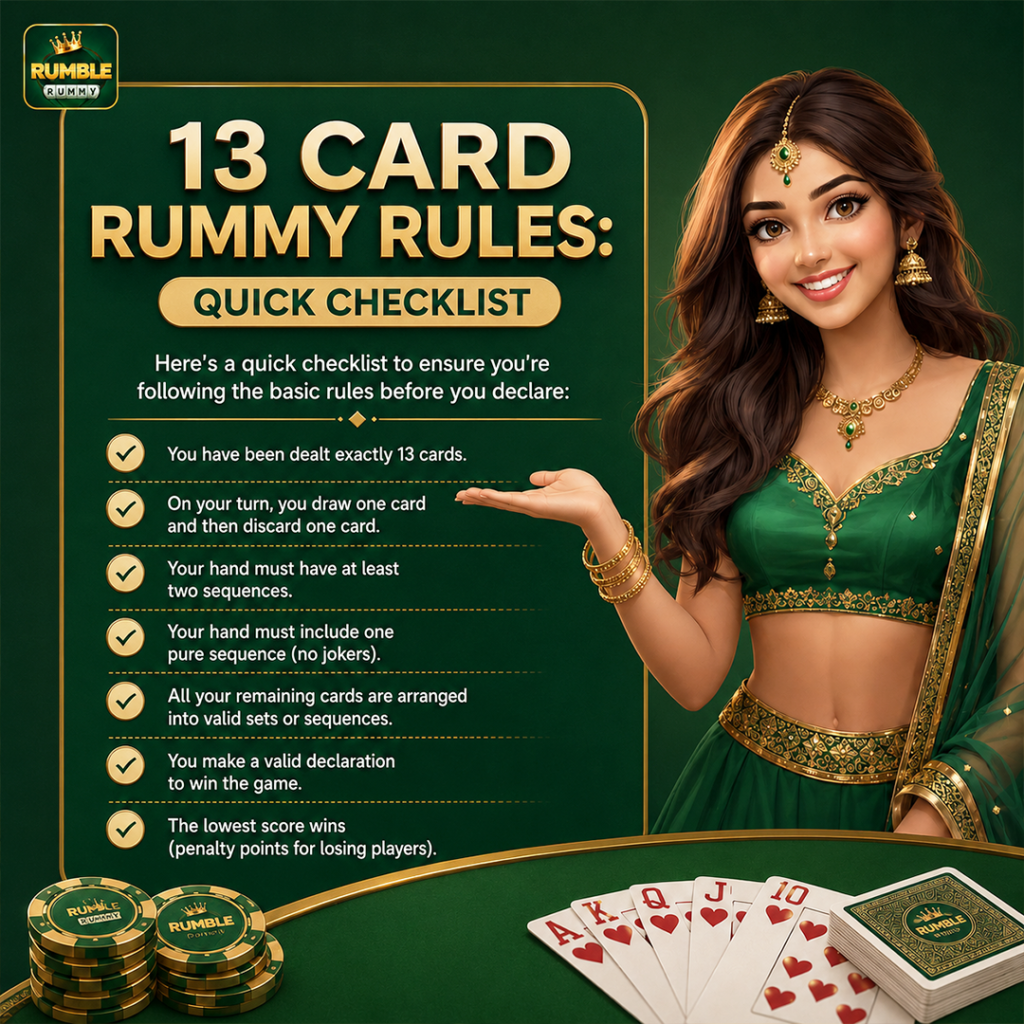
Quick checklist before you declare
- You hold exactly 13 cards after placing your finish card.
- You have at least two sequences.
- One sequence is pure.
- Every other card sits in a valid set or sequence.
Play 13 card rummy18+ only · T&C apply
When you feel ready to try the 13 card rummy rules at a real table, the Rumble Rummy games page explains each format. Get the Rumble Rummy app and start with free or low stake tables.