
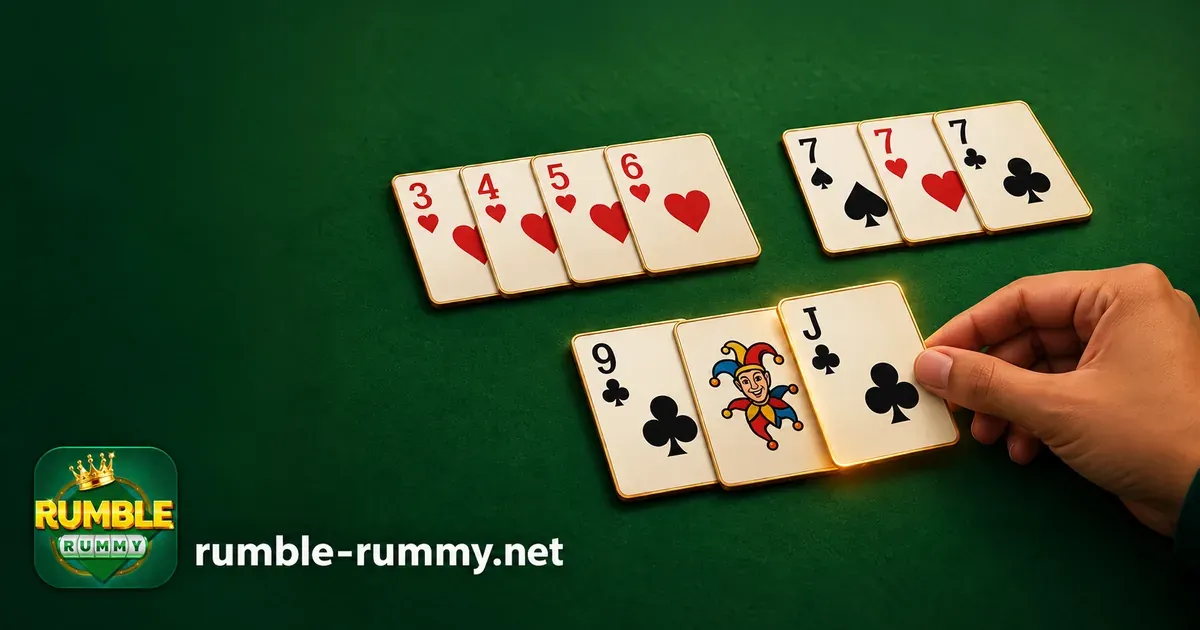
Indian rummy rules decide whether a hand wins, scores a few points or costs the full 80. Most players learn the basics at home, but a handful of rules only show up in edge cases, and those are the ones beginners get wrong. Here are the complete Indian rummy rules for the 13 card game: what counts as a valid group, how jokers and the ace work, how a hand is scored, and the cases that turn a winning position into a penalty.
Want to play a hand from the deal to the declaration? learn rummy step by step. Keep this rulebook open for any question at the table.
The objective under Indian rummy rules
Indian rummy is played by two to six players with two standard decks and their printed jokers. Each player is dealt 13 cards, one card is turned face up to set the wild joker, and the rest form the closed deck.
The goal is to arrange all 13 cards into valid sequences and sets, then declare. Under Indian rummy rules a hand only wins if every card belongs to a group and the hand meets two conditions. Miss either and the declaration is invalid.
- The hand must contain at least two sequences.
- At least one of those sequences must be a pure sequence, with no joker standing in for a card.
Valid groups: sequences and sets
There are two kinds of valid group, and the Indian rummy rules for each are strict.
Sequences
A sequence is three or more consecutive cards of the same suit. A pure sequence uses no joker. An impure sequence uses a joker to fill a gap and is valid as long as it is not your only sequence. Every edge case is in pure sequence.
4♥ 5♥ 6♥ is a pure sequence. 4♥ 5♥ and a joker is an impure one.
Sets
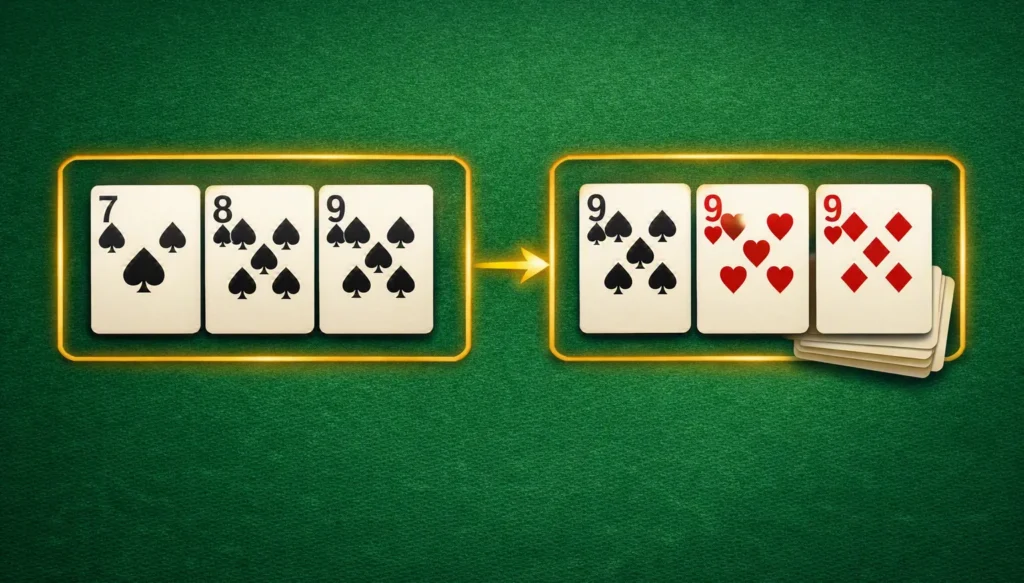
A set is three or four cards of the same rank in different suits. Two cards of the same suit break the set, even when the ranks match and two decks are in play.
7♣ 7♦ 7♠ is a valid set. 7♣ 7♦ 7♣ is not.
A four card set can hold all four suits. You cannot have five cards in a set, because there are only four suits.
The first life and second life
Experienced players use two terms that describe the conditions above in the language you hear at the table.
The first life is your pure sequence. Until you have it, nothing else in your hand counts. The second life is your second sequence, which may be pure or impure. Once you hold both lives, the rest of your cards are free to form sets.
The order matters. Build the first life before the second, and both before you spend time on sets, because without the two lives no set will save you. That one habit follows directly from the Indian rummy rules on declaring and on scoring.
Joker rules in Indian rummy
Two kinds of joker exist, and both behave the same way in play.
The printed joker comes in the deck. The wild joker is set at the start of each deal when a card is turned face up: every card of that rank becomes a joker for the deal, in all suits and in both decks.
A joker can stand in for any missing card in a set or an impure sequence. It cannot fill a gap in a pure sequence, because that makes the sequence impure. A wild joker card can still sit in a pure sequence when it plays as its own natural value, such as the 7♥ in 6♥ 7♥ 8♥ when sevens are wild.
One special case in Indian rummy rules: if the card turned up to set the wild joker is itself a printed joker, many tables make the ace the wild joker for that deal. House and app rules differ here, so check before you rely on it.
The ace rule
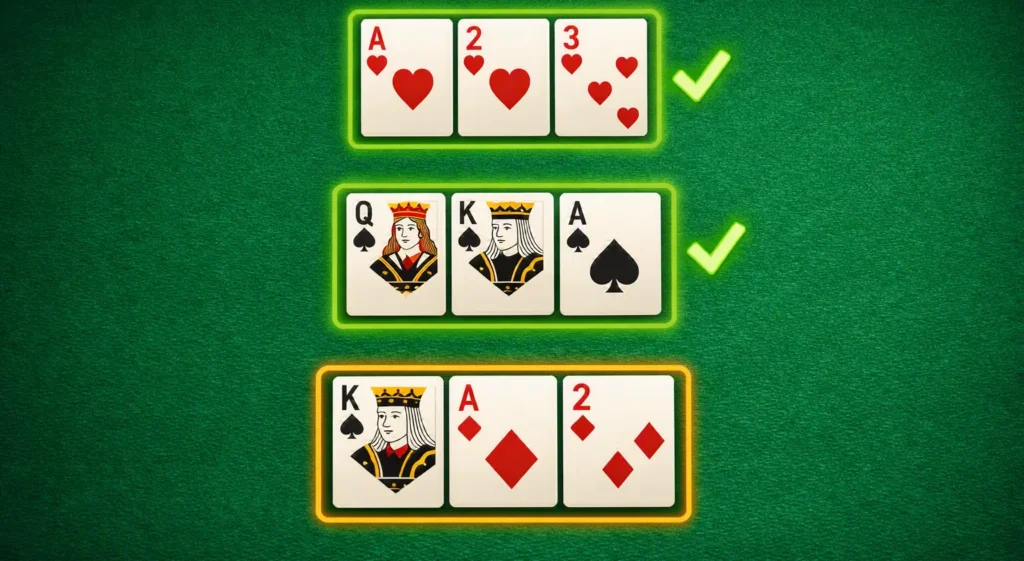
The ace can be played high or low, but not both at once. It sits below the two, as in A, 2, 3, or above the King, as in Q, K, A. It cannot bridge the two ends, so K, A, 2 is not a valid sequence. This one rule causes a large share of invalid declarations, so it is worth checking every time an ace sits in a run.
For scoring, an ungrouped ace counts 10 points.
Scoring rules
Under Indian rummy rules, points are bad. The winner scores zero, and every other player counts the cards left unarranged in their hand. Cards inside a valid group do not count, as long as the player has the required sequences.
| Card | Points |
|---|---|
| Ace, King, Queen, Jack | 10 each |
| Cards 2 to 10 | Face value |
| Jokers | 0 |
| Cards inside a valid group | 0 |
| Maximum for one hand | 80 |
The 80 point cap matters. No matter how many high cards you hold, a single deal cannot cost more than 80 points.
There is one catch. A player without a pure sequence counts every card in the hand, even cards in complete sets. A player with a pure sequence but no second sequence counts everything except the pure sequence.
Drop rules
If your opening hand is hopeless, Indian rummy rules let you leave the deal early and take a smaller loss.
| When you drop | Typical penalty |
|---|---|
| Before your first draw (first drop) | 20 points |
| Later in the deal (middle drop) | 40 points |
| Playing to the end with an unarranged hand | Full count, up to 80 |
These are common values on rummy apps. Home games use different numbers, and pool rummy tables often set their own, so confirm the drop rules of your table. The Points, Pool and Deals formats page explains how drops work in each format.
Invalid declaration rules
Declaring without meeting the conditions is the most expensive mistake in the game. If you declare without two sequences, without a pure sequence, or with a group that does not hold up, the declaration is invalid and you score the maximum of 80 points, however well the rest of the hand was arranged. Count your groups twice before you finish.
Common causes of an invalid declaration:
- An ace used to wrap around, as in K, A, 2.
- A set with two cards of the same suit.
- A joker in what you thought was your pure sequence.
- One card left over after grouping.
Variations of Indian rummy
The 13 card game here is the standard, but you will meet a few variations built on the same Indian rummy rules:
- Points rummy: a single deal with a cash value per point.
- Pool rummy: repeated deals, where crossing 101 or 201 points knocks you out.
- Deals rummy: a fixed number of deals played with chips.
- 21 card rummy: a longer variant with 21 cards, three decks and extra jokers, with its own scoring.
The core rules, sequences, sets, the two lives and the joker rules, stay the same across the 13 card formats. Only the structure around the hand changes.
Practise the rules for free
The fastest way to learn Indian rummy rules is to play them, and you do not need to risk money to do it. Practice tables run the same rules with chips that have no cash value, so a rule you get wrong costs you nothing but a lesson.
Practise on Rumble Rummy18+ only · T&C apply
Ready? start playing Rumble Rummy and set a budget before you ever play for money.